
Penwyll Map in Withering Realms
Town hub, Clocktower, Mazechapel, opening routes, and the guardians that grow the world.
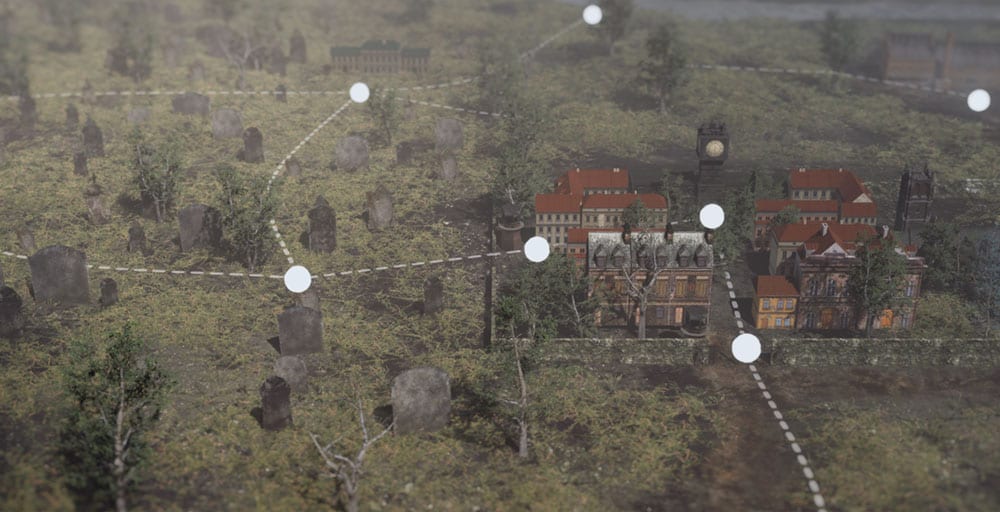
Penwyll is the map, not a loading screen. Withering Realms is a single-player horror action RPG that treats this Welsh-inspired town as a hub you keep walking, not a menu you click through. Steam Early Access is dated 2 September 2026. You play Clover, a nine-year-old ghost, piloting a two-metre doll through streets that only exist once perimeter guardians fall. If you treat the world map as fog that fills itself, you will stand in the Clocktower square and wonder why the next field is still a wall.
This page is an atlas of places the game actually names. For the first-hour route, use the opening walkthrough. For binds and the first levels, use Getting Started. For how night rewrites the same dirt, use the night cycle. For the fights that unlock roads, use bosses. For the 110-entry catalogue of things that live on those roads, use the bestiary.
How the map grows
The world map expands by defeating perimeter guardians. That is a travel rule, not flavour. A closed road around Penwyll is usually a fight, not a missing key item and not a bug. Guardians sit on the ring. When they fall, a new slice of the Occult Frontier becomes walkable: another field, another rotting estate, another approach toward a landmark you could already see from town.
Do not farm the first guardian as a loot piñata. The drop is the road. Come back later for night secrets on the same ring; the unlock is the daylight job. If a guardian stuffs you, change the hour before you scrap a craft. Day and night are both legitimate approaches to the same gate. Tactics without later names live on the bosses page.
Seven large dungeons sit behind that ring over the course of Early Access. This atlas will not invent their titles. The names you get here are the ones public materials already use: Penwyll, Clocktower, Mazechapel, Beynon House, Saintswood. Everything else is a direction, a silhouette, or a rumour from an NPC who has not earned a spoiler.
Beynon House, then Saintswood
Beynon House is the intro dungeon, not the town. Clover wakes there. You learn the 3/4 top-down camera, the birdcage puzzle, and the scarecrow that can look like a prop. The house is a classroom with a health bar. Leave it when you can tell furniture from a waiting body. The walkthrough covers that classroom in order; this page only places it on the map: a decaying mansion before the first field.
Saintswood is the first field. It is larger than the house, more honest about grass you have not scanned, and the first place the world map starts to feel like a frontier instead of a corridor. Walk the edge. Mark a tree. Come back. Optional loops hide crafts and talismans you will want once Penwyll’s shops are open. The first two bosses live in this opening stretch. They are homework for spacing, not a catalogue of later names.
If you sprint from the house to town without a night pass through Saintswood, the field is only half drawn. Pitch-black grass and Clover’s faint glow are the other half. The night cycle is the companion page; this atlas just insists that Saintswood has two stamps.
Penwyll as a hub
Penwyll is Welsh-inspired and busy on purpose. Shops sit on streets you will reuse. NPCs keep hours. A repair shop builds gadgets for the doll’s missing right arm. Replacement eyeballs show up as shop upgrades if you keep walking into furniture. The Clocktower and Mazechapel are landmarks you can navigate by, not dungeon titles this page will spoil. Use them as compass points. A rumour that points at the Clocktower is a direction. A fight that gates the Clocktower approach is a guardian problem.
Do not treat the repair shop as a tourist stop in the first twenty minutes. Walk there when you have parts and a reason to craft. Early Access lists about fifty weapons and tools and seventy talismans; the bench will not hand you that list for standing in the doorway. Body, left arm, and right arm still level separately. The shop is where those tracks become metal. Getting Started is the spending advice; this page is the address.
Town at noon is shops and gossip. Town after dark is a different bestiary. New creatures spawn. Secrets that were a blank wall become a crawlspace. NPC hours change. The Clocktower and Mazechapel look like civic buildings by day and like problems after dusk. Revisit. Colouring the map once is how you miss Penwyll.
Night revisits and the ring
Night is pitch black. Lighting is physical. Clover’s glow is visible after dark and washed out by day. The ring around town is the real night dungeon even when it looks like a road. Perimeter guardians are night-sensitive: a kite that worked at noon can fail in a hole you cannot see. Bring a left-hand tool you trust and a plan for light. Enchanted Candelabrum is a right-arm craft that happens to throw light; it is still a weapon, not a map cheat.
Some areas randomize on entry. That is not a roguelike wipe. Death does not remove items, crafts, or story. A night death on the ring is a lighting lesson and a routing note. Walk the same perimeter again with a lamp you actually placed.
The bestiary is how you remember what changed. A blank line in the catalogue after a noon clear is a prompt to return, not a missing download. Log hour and density, not a fan-made title for the thing in the hedge.
Two grammars of the same streets
The doll’s 3/4 view wants spacing, secondary melee, and a craft in the missing arm. Althea wants interrogation, lockpicking, forgery, and fixed cameras. Her work uses Penwyll’s paper, keys, and gossip. Clocktower and Mazechapel are the kind of public buildings a reporter can have business in without a flamethrower. Perimeter guardians still belong to the doll. Map expansion is a combat gate. Althea replaces the doors that were never fights.
Do not import a Machinegun into a lockpick window. Do not import a lockpick into a guardian. Switching registers is a map skill: the same street can be a pack fight at dusk and a filing cabinet at midnight.
English is the Early Access language. Extra languages and consoles belong to the 2027 1.0 plan. The campaign is single-player. There is no shared-session scout marking your fog.
Treat Penwyll as a ring you walk twice, not a stamp book you finish at noon. Beynon House taught you a house. Saintswood taught you a field. The Clocktower and Mazechapel taught you where to look. Guardians taught you that looking is not the same as arriving. Night taught you that arriving is not the same as seeing. Leave one flask unspent, leave one street unmarked, and come back when the glow is the only honest lamp on the road.
Frequently Asked Questions
Quick answers for Penwyll, the doll, and Early Access.
How does the world map actually expand?
By defeating perimeter guardians. A closed road around Penwyll is usually a fight, not a missing key. Tactics without later names live on the bosses page.
What places does this atlas name?
Penwyll, Clocktower, Mazechapel, Beynon House, and Saintswood. Later dungeon titles are omitted on purpose. Opening-hour routing is on the walkthrough.
Should I visit the repair shop immediately?
No. Walk there once you have parts and a reason to craft. Getting Started covers spending; this page is the address of the bench.
Why walk the same streets at night?
Night is pitch black, with new creatures and secrets. Clover's glow is visible after dark. The night cycle explains lighting; the bestiary is how you remember what changed.
Do Althea's sections use the same map grammar?
No. Her work is interrogation, lockpicking, forgery, and fixed cameras. Perimeter guardians still belong to the doll. See Althea.
Is this a roguelike map wipe?
No. Some areas shuffle on entry, but death does not remove items, crafts, or story. Withering Realms is single-player. A night death on the ring is a lighting lesson.